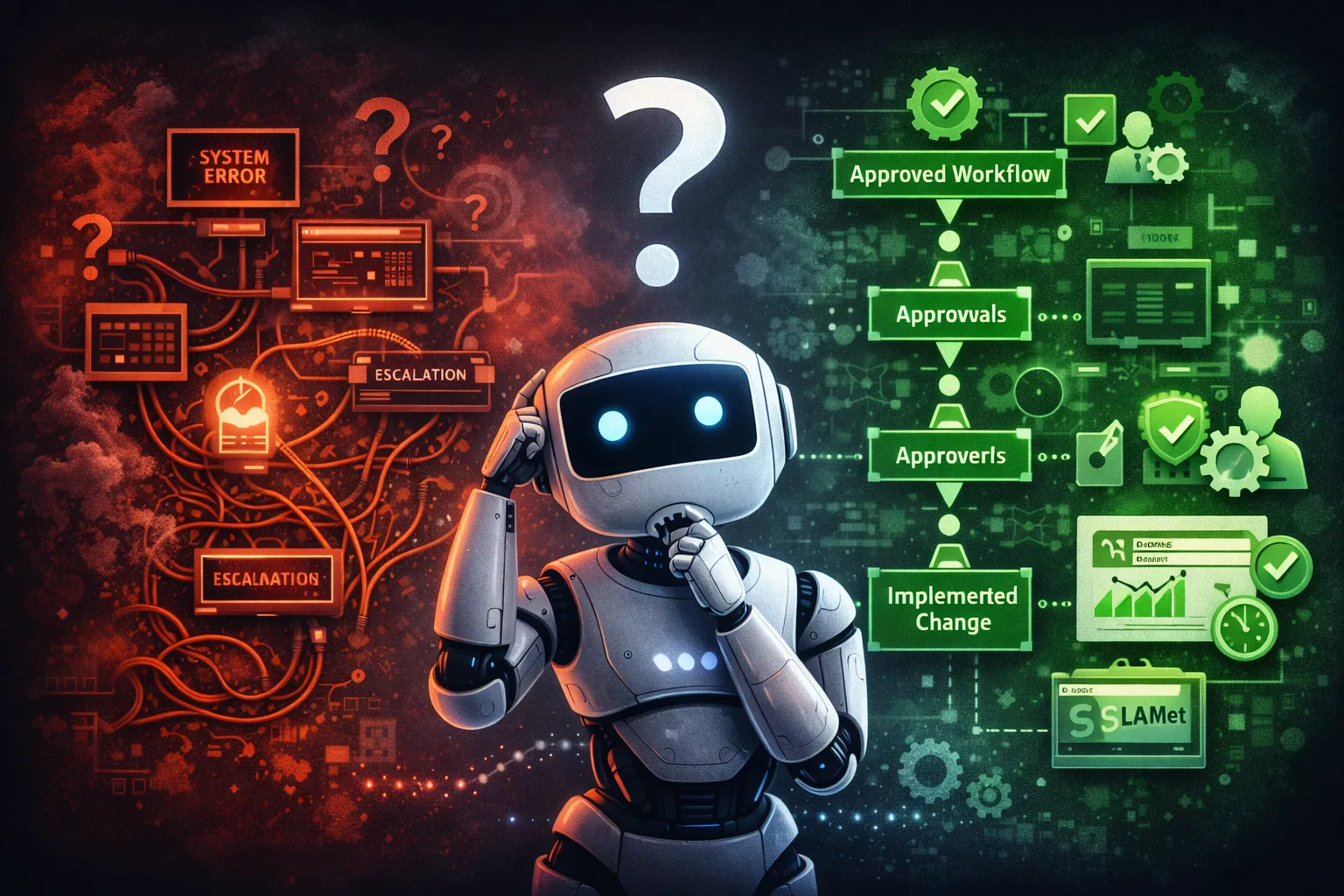
Automation is more accessible than it has ever been. Workflow tools, automatic ticket routing, AI-assisted categorization, automated change approvals — technically, almost anything in ITSM can be automated. The interesting question is not what can be automated, but what should be. In ticket handling and change management, automation usually brings speed, and speed tends to be mistaken for improvement. It isn't the same thing.
Automating an unclear process
Take change management as the canonical example. An organization rolls out a workflow where changes are automatically assigned to a coordinator, approval requests fire on their own, implementation tasks spawn after approval, and records close automatically once work is done. On paper it looks structured and under control.
The problem is usually what wasn't answered before the workflow was configured: who owns the risk of a change, who has final decision authority, what separates a standard change from a high-risk one, and who is empowered to stop a change that looks wrong. If those questions were never clarified, automation does not resolve them — it accelerates the confusion around them. The system runs, but the process doesn't. Automation amplifies whatever already exists, and a weak process automated is simply a weak process running faster.
Notification fatigue and parallel approvals
A common pattern in ticketing and change workflows is to notify on every status update, escalate automatically after time thresholds, and require parallel approvals from several stakeholders. In theory, this layers on control. In practice, approvers end up drowning in dozens of emails a day, real decisions migrate out of the tool into calls and chats, and the ticketing system becomes a formal trace rather than a management instrument. When every update triggers a notification, people stop reading them. Automation without prioritization creates noise, and noise erodes trust in the system faster than any individual bug.
Automation without a clear support structure
Most IT organizations operate with three tiers of support: L1 for standard, repeatable requests, L2 for technical specialists handling more complex issues, and L3 for expert teams or external vendors. Automatic assignment only works if responsibilities at each tier are clearly defined. When they aren't, L1 forwards to L2, L2 bounces back for missing information, L3 waits on clarification, and the ping-pong effect isn't eliminated — it just runs at higher speed.
For routing automation to deliver real value, the organization has to know which tier handles which request types, where responsibility begins and ends between tiers, who communicates with the end user, and who actually owns the service. Without that structure, routing rules are just a faster way to move the same problem around.
SLA and measurability
An SLA defines expected service performance — incident response in 30 minutes, critical resolution in 4 hours, standard change approval in one business day. It is normal to automate escalations when SLA thresholds are exceeded. But if the organization doesn't consistently measure real performance, analyze why SLAs are breached, track time spent in each workflow stage, and evaluate handovers between support levels, those escalations become reactive noise rather than performance management.
The right question isn't "do we have automated escalations?" It is "did our measurable performance actually improve?" Did average resolution time drop by 20%? Did cross-tier transfers decrease? Did the volume of emergency changes fall? Did change success rate improve? If those numbers don't move, the automation is probably addressing symptoms instead of root causes.
AI in ticketing and change management
AI is legitimately useful for categorizing tickets, suggesting solutions, recommending change approvals from historical data, and identifying patterns in recurring incidents. That is real, deployable value. The trouble starts when AI closes tickets without human validation, recommends approval of risky changes without context, or reassigns requests without understanding business impact — because at that point, accountability becomes unclear. AI should support decision-making, not replace it. In change management especially, auditability and accountability are non-negotiable. When AI helps a change coordinator assess risk, it adds value. When AI is making the decision itself, governance blurs.
When automation works well
Automation delivers the most value when the process is stable and clearly defined, roles and responsibilities are explicit, there is a named process owner, and objectives are measurable. In ticketing, if a specific request type always follows a standardized procedure, automatic routing and predefined templates cut handling time without adding risk. In change management, when standard changes are well-defined and low-risk, a simplified automated approval path safely reduces administrative overhead. In both cases, automation is amplifying stability rather than chaos.
Responsible automation
Before automating any part of ticketing or change management, the questions worth asking are straightforward: Is the process stable or still evolving? Are responsibilities clearly defined? Is there a named owner? What happens when automation fails? How will we measure whether it worked? Automation is a tool, not a strategy. If the goal is simply "to implement AI" or "to have workflow automation," complexity goes up without any guarantee of improvement. If the goal is to reduce risk in change management, improve SLA performance, increase service transparency, or eliminate unnecessary escalations, automation can be a powerful accelerator — but only toward a destination that was already clear.
Pressure to be more efficient is a natural part of running IT, and automation is a logical step. But one principle holds across ticketing and change management: automation does not fix a broken process, it only makes it run faster. Fast chaos is still chaos. The real question isn't whether to automate. It's whether you are automating the process — or just the problem.