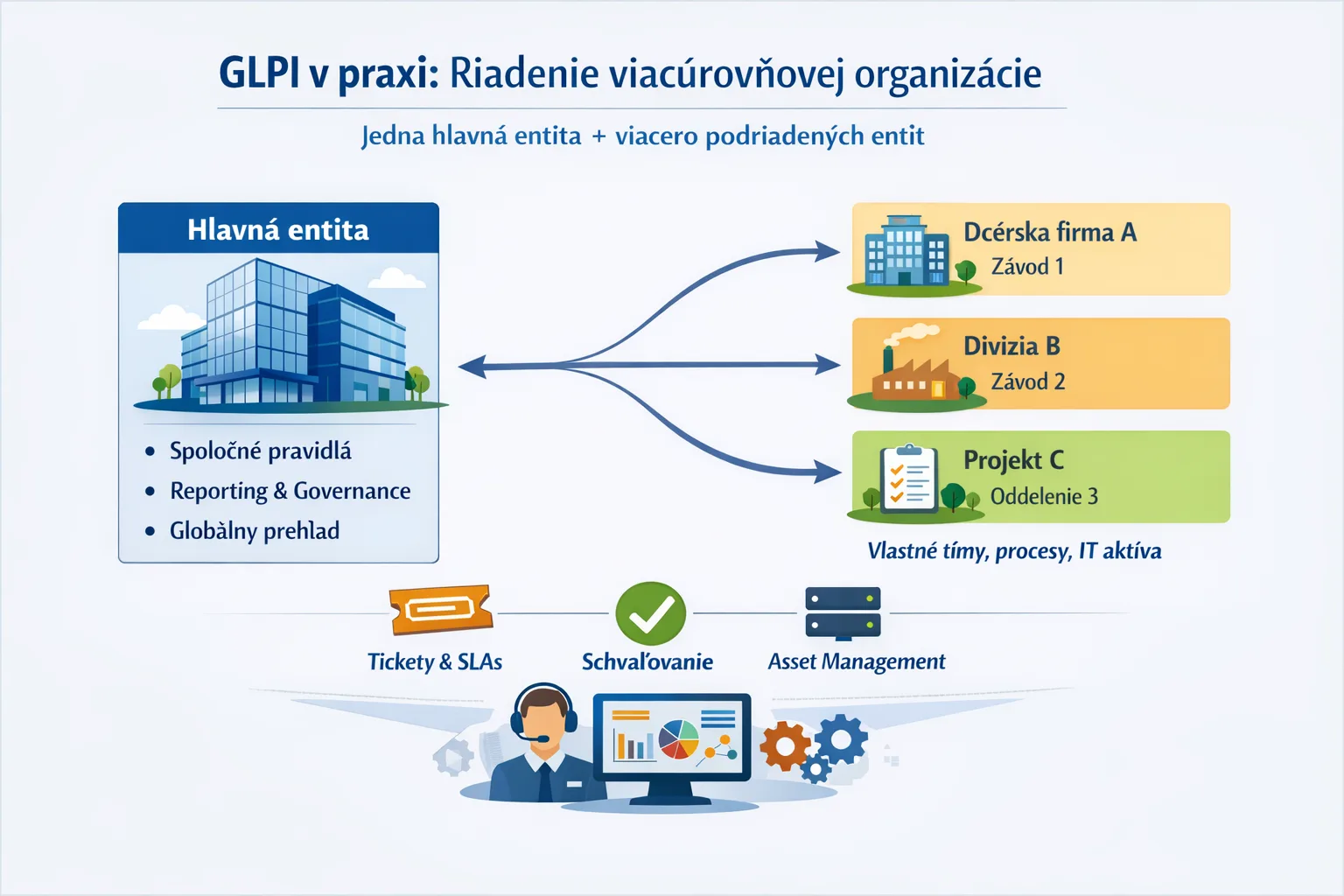
As companies grow, IT often faces a familiar problem: one Service Desk system must support multiple organizational units with different needs, responsibilities, and levels of autonomy — while management still expects central control, visibility, and reporting.
The usual outcomes aren’t great. Either multiple separate Service Desk tools emerge (fragmented data, duplicated effort), or everything is forced into a single flat structure that becomes hard to manage and even harder to scale.
This is exactly where one of GLPI’s strongest capabilities comes into play.
GLPI in practice: Managing complex organizations with entities
One of the most powerful features of GLPI is its entity model. Entities allow a single GLPI instance to support complex organizational structures — without running multiple systems.
One main entity, multiple sub-entities
A common real-world setup looks like this:
- Main (root) entity – central IT, shared rules, governance, global reporting
- Sub-entities – subsidiaries, plants, divisions, departments, or projects
Entities are hierarchically linked, but each can remain independent where needed.
What entities allow you to control
- Users and roles – clear visibility and access boundaries
- Tickets and processes – incidents, requests, and changes handled locally or centrally
- Approvals – local approval chains aligned with central governance
- Asset management – assets owned by entities, with consolidated oversight
- SLAs and notifications – different rules for different parts of the organization
How entities work together
Entities in GLPI are not isolated silos:
- central teams can work on tickets from sub-entities
- selected objects (categories, templates, SLAs, forms) can be shared downward
- reporting can be local or fully aggregated across the organization
The result is a balance many organizations struggle to achieve: local flexibility combined with central control.
Who benefits most from this model
- holdings and corporate groups
- public sector organizations and agencies
- manufacturing companies with multiple sites
- IT outsourcing models (multiple customers in one GLPI instance)
If your GLPI setup is growing and entities feel more like a limitation than a benefit, the right entity architecture design can simplify the situation significantly.